

Today's AI Briefing: Google DeepMind Launches Robotics Accelerator, Accepting 15 European Startups
Google DeepMind announces the launch of a European Robotics Accelerator program, selecting 15 hands-on startups across construction, healthcare, marine, and waste recycling for three months of mentorship and AI technical support.
Preface
AI's potential isn't limited to the digital world — its applications in the physical world are just as compelling. Google DeepMind recently announced the "Google DeepMind Accelerator: Robotics" program, selecting 15 early-stage robotics startups from across Europe. These teams will undergo three months of intensive mentorship in London, with access to Google's AI tech stack, technical expert guidance, and support from Gemini robotics models.
Below is a demo video from one of the selected teams, Qualia, training embodied intelligence models in real physical environments — not lab demos — with robots actually performing manual tasks.
Qualia's robot movements in the video are genuinely striking, nothing like the stiff, mechanical robots of conventional impressions. The motion control is exceptionally fine-grained and smooth, with astonishing flexibility and trajectory fluidity during grasping and adjustments...
Program Highlights and the Hardcore Startups
The 15 selected startups span industrial, medical, environmental, and even space domains. Their shared core goal is translating cutting-edge AI research — language, vision, motion models — into safe, practical, and adaptable physical robotics applications.
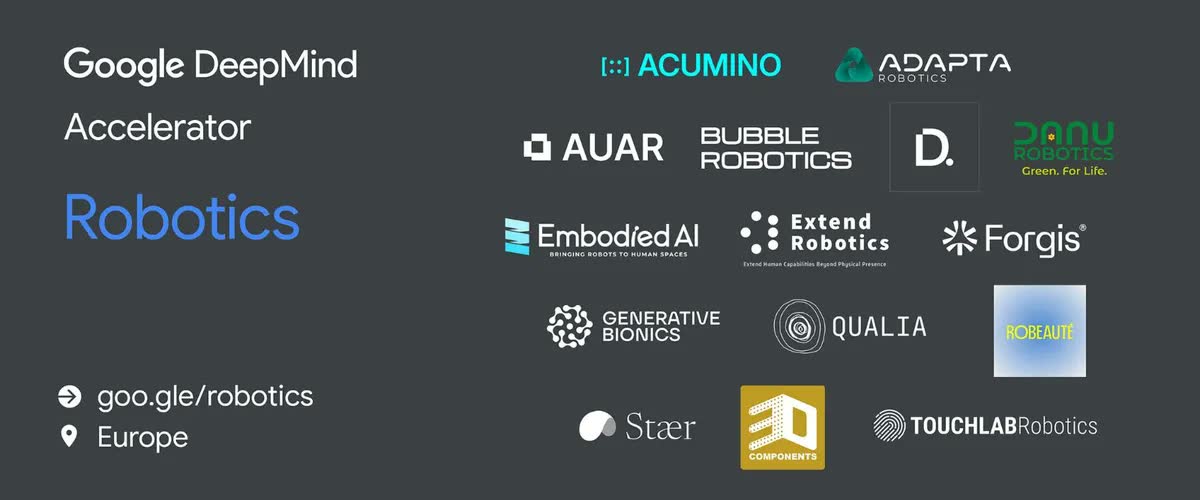
Google DeepMind Accelerator selects 15 robotics startups to join the program
A few names in the cohort stand out:
- Qualia (Denmark): Building infrastructure to deploy Robotic Foundation Models on real job sites, directly replacing humans for highly repetitive, time-consuming manual labor.
- ROBEAUTE (France): Developing micro-robots that can navigate brain tissue to diagnose, treat, and monitor neurological diseases — bringing a new physical infrastructure to neurosurgery.
- AUAR (UK): Reducing home construction costs by deploying robotic MicroFactories directly on building sites.
- 3D-Components AS (Norway): Building the AI-driven platform RobTrack that autonomously optimizes metal 3D printing and welding parameters — 280x faster than traditional methods.
- Bubble Robotics (France): Building autonomous marine work crews made of self-docking surface and underwater robots, eliminating the need for support vessels and creating real-time models of the underwater world.
Why This Technology Matters
Everyone is talking about embodied AI right now, and it's the inevitable direction for robotics.
A lot of robot demonstrations in the past felt like carefully choreographed stage plays — running demos only in controlled, interference-free lab environments. But the teams selected for this program — Qualia being a prime example — are focused on something different: getting robots to adapt to messy, real-world conditions and perform concrete physical labor.
By combining the reasoning capabilities of large language models with vision-action models, robots no longer need hardcoded instructions for every micro-movement. Instead, they can observe, understand, and manipulate on their own. Watching Qualia's demo footage — that near-human, rhythmic, finely smooth motion control — this kind of technology, deployed on actual factory floors, is what will truly change the structure of productivity.