

MIT's Y-Zipper Variable-Stiffness Structure: A Three-Way Zipper That Turns Fabric into Rigid Plate
MIT researchers unveil Y-Zipper, a variable-stiffness structure made with 3D printing and a zipper locking mechanism that switches between soft fabric and rigid support — with potential applications in tents, medical devices, soft robotics, and deployable space structures.
MIT recently published an interesting piece of materials research: they designed a structure called Y-Zipper that behaves like soft fabric in its natural state — foldable, bendable, twistable — but once locked through a special zipper mechanism, its stiffness jumps dramatically and it turns into a load-bearing solid structure.
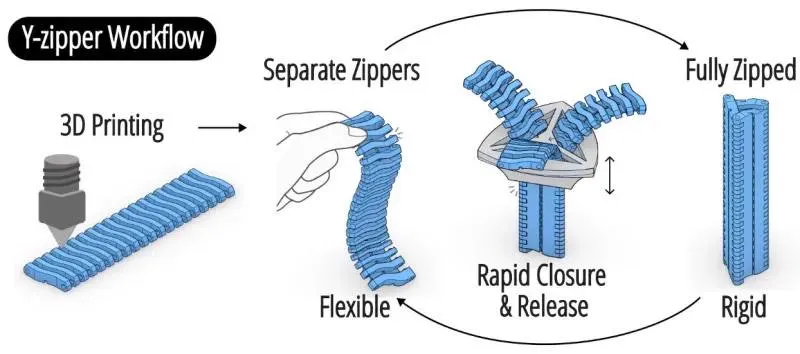
How It Works
The key to Y-Zipper is the "three-way" zipper mechanism. A conventional zipper has two rows of teeth that lock into a single stiff direction. Y-Zipper introduces a third direction — after locking, the three axes constrain each other, turning a soft planar material into something that behaves mechanically like a solid sheet.
Fabrication
The technique is entirely 3D-printed. The team uses a thermoplastic material to print the Y-Zipper structure in one piece — no assembly required. Once the print finishes, the deformable structure is ready to use.
Potential Applications
The team is currently exploring four main directions:
- Rapid-deploy tents and temporary shelters — packs like a bundle of fabric, then locks into a load-bearing structural frame when deployed
- Shape-adaptable medical devices — splints or casts that a doctor can mold to the patient's body before locking into shape
- Soft robotics — localized stiffening on demand for gripping and support
- Future deployable space structures — rocket payload volume is tight; compress during launch, expand and lock once in orbit
Why This Matters
We tend to think of "soft" and "stiff" as two completely separate material categories, but work like Y-Zipper is blurring that line.
From an engineering perspective, variable stiffness may matter more than it first appears. A lot of robots, medical devices, and even space hardware don't actually need to stay rigid all the time — they need to become rigid when it counts.
Some future products might ship like a piece of cloth and deploy into a structure that can hold weight. That's not just a fun material science experiment — it could change how we think about designing portable structures.